
A city that grew from 4,000 to nearly 68,000
Tree Service in Madison, AL
Shaping the trees that came with new subdivisions and caring for the old ones near the depot.
- Free on-site estimates across Huntsville and Madison County
- Each tree listed with its own price in writing
- You choose what stays: chips, logs or nothing
A Fast-Growing City With Two Kinds of Trees
Most calls for tree service in Madison fall into two groups. There are the trees a builder planted in the front yard twenty or thirty years ago that now crowd the roof and the driveway, and there are the big hardwoods on older lots near downtown that predate most of the city around them. Pro Tree Service Huntsville works with both, and the right plan for one is usually wrong for the other.
How fast Madison grew
Census counts show the story: 4,057 people in 1980, 14,904 in 1990, 29,329 in 2000, 42,938 in 2010 and 56,933 in 2020. The Census Bureau's 2025 estimate is 67,968. Nearly all of that growth came as subdivisions, many of them on former cotton fields with little or no existing canopy. The trees on those lots were planted at the same time, often the same few species, and they are now reaching the size where weak forks and crowded limbs start to matter.
Builder trees at middle age
A tree planted as a sapling in the 1990s has had three decades to put on weight. Some fast-growing ornamentals sold heavily in that era form tight, upright forks that split under wind or ice once the tree is large. Others were planted a few feet from the house to look full on day one. Good structural pruning, done to ANSI A300 standards, can thin a crown, shorten a competing leader and lift limbs off the roof without topping the tree. When a tree has already split or is simply too close to the foundation, removal and stump grinding can be the cleaner answer, and we will say so in the estimate.
Older Madison
The city began as Madison Station, a stop on the Memphis & Charleston Railroad in the 1850s, and was incorporated on December 2, 1869. The Madison Historic District joined the National Register of Historic Places in 2006. Lots around the old town center tend to be smaller and more irregular, with mature trees close to porches, fences and overhead service lines. Those jobs usually mean climbing and lowering wood in pieces by rope rather than felling, and keeping trucks off soft lawns.
Ownership and planning
About 74% of Madison homes are owner-occupied according to Census QuickFacts, and 85.8% of residents lived in the same house a year earlier. People here tend to plan ahead, which is good for trees: a pruning pass every few years costs less, and stresses the tree less, than a crisis removal after a storm. If you are in an HOA, check whether your covenants say anything about removing or replacing front-yard trees before you schedule work.
Services in Madison
- Structural pruning for young and middle-aged subdivision trees
- Crown cleaning and raising over roofs, decks and driveways
- Removal of split, dead or badly placed trees
- Stump grinding so new sod or a replacement tree can go in
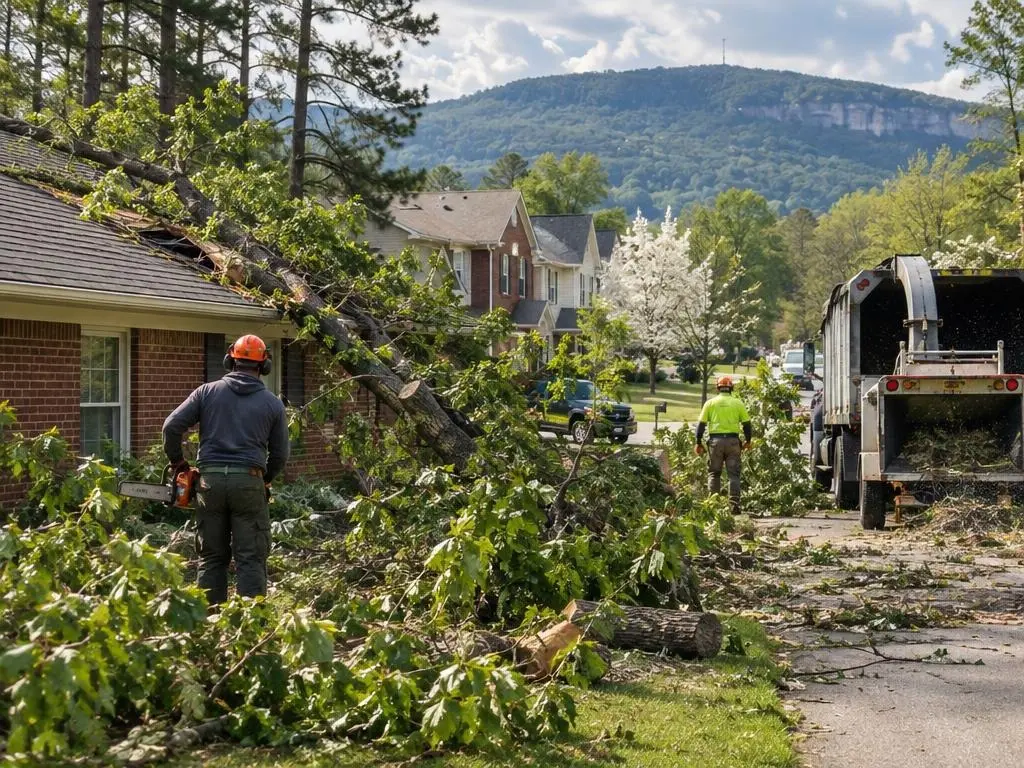
- Storm damage and emergency tree removal
Call (938) 666-8748 to set up a visit. Get a free estimate
Madison by the Numbers
- Growth in four decades. Madison went from 4,057 residents in 1980 to 56,933 in 2020, and the Census Bureau estimates 67,968 for July 2025. Much of that was new subdivision housing with trees planted all at once.
- Two counties. The city lies mainly in Madison County and extends west into Limestone County, with about 30.4 square miles of land.
- Owner-occupied homes. Census QuickFacts lists a 74.0% owner-occupied rate and a median owner-occupied home value of $398,800 for 2020-2024, with 2.66 people per household.
- Railroad-era center. Madison grew around a Memphis & Charleston Railroad stop in the 1850s, was incorporated on December 2, 1869, and its historic district was added to the National Register on March 29, 2006.
Madison Questions
My front-yard tree is only 25 years old but it split down the middle. Was that preventable?
Often, yes. Trees with two equal stems joined at a tight angle are prone to splitting as they grow heavy. Pruning to favor one leader while the tree is young usually prevents it. Once it has split, the tree typically needs to come down.
Does my HOA have to approve tree removal in Madison?
It depends on your covenants. Many subdivisions have rules about front-yard trees or replacements, so read yours or ask the board before scheduling. We can give you a written estimate to submit with any request.
Do you work on the Limestone County side of Madison?
Yes. We cover the whole city, including the western neighborhoods that fall in Limestone County, along with nearby Monrovia, Harvest and Triana.
How often should subdivision trees be pruned?
For most shade trees, a structural pruning visit every three to five years while they are young keeps them in good shape. Mature trees may only need deadwood and clearance work every several years.
Free Estimates in Madison, AL
Free estimates in Madison, from the historic district to the newest subdivisions.
Tree Service Near Madison
- Tree Service in Huntsville, AL
- Tree Service in Harvest, AL
- Tree Service in Meridianville, AL
- Tree Service in Hazel Green, AL
- Tree Service in Moores Mill, AL
- Tree Service in New Market, AL
- Tree Service in Gurley, AL
- Tree Service in Owens Cross Roads, AL
- Tree Service in Triana, AL
- Tree Service in Monrovia, AL
- Tree Service in Athens, AL
- Tree Service in Decatur, AL
- Tree Service in Mooresville, AL
- Tree Service in Priceville, AL
- Tree Service in Trinity, AL
- Tree Service in Ardmore, AL
- Tree Service in New Hope, AL
- Tree Service in Hampton Cove, AL
- Tree Service in Toney, AL
- Tree Service in Elkmont, AL
- Tree Service in Lacey's Spring, AL
- Tree Service in Grant, AL
- Tree Service in Brownsboro, AL
- Tree Service in Tanner, AL